

How to write an event description that gets bookings
A simple structure for event descriptions that sell: a clear title, an opening line, what you will do and what to know. With examples for classes and meetups.
· 5 min read
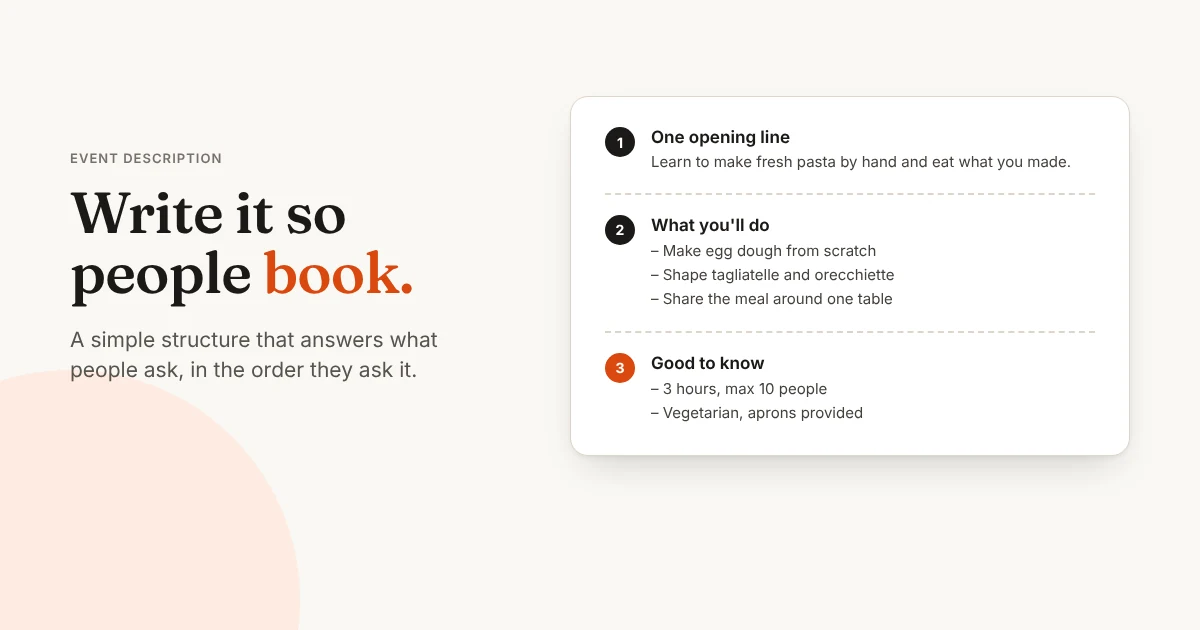
Most people decide whether to book in the first ten seconds on your page. They glance at the title, read the first line, scan for the price and the time, and either click “Book” or leave. A good event description is not long or clever. It answers their questions in the order they ask them.
This guide gives you a structure that works for almost any small event, a few real examples, and a shortcut if you’d rather not start from a blank page.
The questions people ask, in order
When someone lands on your event page, they are silently asking:
- What is this? In plain words, not a slogan.
- Is it for me? Level, age, experience, group size.
- What will I actually do? The activity, not the mood.
- What do I need to know? Duration, what’s included, what to bring, where to go.
- How much, and when? Your booking page shows price and dates, so the text doesn’t need to repeat them.
If your description answers these five, it will convert better than a beautifully written paragraph that doesn’t.
Start with the title
The title does the heavy lifting. Say what people will do, and for whom if it matters.
| Instead of | Try |
|---|---|
| Clay Night | Wheel throwing for beginners |
| Find your flow | Vinyasa workshop: arm balances for intermediates |
| Taste of Italy | Fresh pasta class: make 3 shapes from scratch |
| Padel Saturday | Amateur padel tournament, pairs, Saturday morning |
| Monthly gathering | Indie game devs meetup: 2 talks and networking |
Keep it under about 60 characters so it isn’t cut off on phones and in Google. Leave out the date and price; they’re already on the page.
A three-part structure that works
1. One opening paragraph
Two or three sentences that set the scene and say what people get. Write to the reader (“you”), and be concrete.
Spend an evening at the wheel and leave with your own handmade cups. In this small-group class you’ll learn the basics of throwing, step by step, with plenty of time to practise.
2. “What you’ll do”
Three or four short lines. Actions, not adjectives.
What you’ll do
- Learn to center clay on the wheel
- Throw your first cups and bowls
- Trim and shape your favourite piece
- Choose a glaze colour for firing
3. “Good to know”
The practical details that stop people from emailing you.
Good to know
- 2 hours, maximum 8 people
- No experience needed
- All clay, tools and firing included
- Wear clothes that can get a little muddy
That’s it. Around 100 to 180 words is enough for most classes and workshops.
Examples for different events
A sound bath
Slow down for an evening of deep rest. You’ll lie back while crystal bowls and a gong fill the room with sound, guided by a short breathing practice at the start.
What you’ll do
- A gentle breathing exercise to settle in
- 60 minutes of live sound with bowls and gong
- A few quiet minutes to come back slowly
Good to know
- 75 minutes, 20 people
- Mats provided; bring a blanket and a cushion
- Not recommended in the first trimester of pregnancy
A cooking class
Learn to make fresh pasta by hand and cook it the way it’s done in Italian homes. You’ll knead, roll and shape the dough yourself, then sit down together to eat what you made.
What you’ll do
- Make egg pasta dough from scratch
- Roll and cut tagliatelle, and shape orecchiette and farfalle
- Cook two simple sauces
- Share the meal around one table
Good to know
- 3 hours, maximum 10 people
- Vegetarian; tell us about allergies when you book
- Aprons provided, recipes sent by email
A meetup
A relaxed monthly evening for people making indie games. Two short talks from local developers, then plenty of time to meet others, share what you’re building and get feedback.
What you’ll do
- Two 15-minute talks with Q&A
- Show-and-tell: bring a build on your laptop if you like
- Networking until late
Good to know
- Free, but please book so we know how many chairs to set out
- Drinks available at the bar, not included
Common mistakes
- Starting with your story. Your background matters, but put it after the “what” or in one line at the end.
- Only adjectives. “Fun, relaxing, unforgettable” tells people nothing. “You’ll take home 3 pieces” does.
- Hiding the practical details. If people have to message you to ask about parking or level, some of them won’t bother and won’t book.
- A wall of text. Short paragraphs and lists read better on a phone, which is where most people will see your page.
- Repeating the price and dates in the text. They change; the text often doesn’t get updated.
The shortcut: let AI write the first draft
If you’d rather not start from a blank page, Passfinch can write the first draft for you. When you create a new event, describe it in one sentence, for example:
Fresh pasta class, 3 hours, max 10 people, €65, vegetarian, aprons provided, in LyonClick Write it for me and you get a title, a description in exactly the structure above, and your ticket types with prices. It’s told not to invent facts, so anything you didn’t mention stays general. You then add your personal touch and save. The full walkthrough is in how to create an event page with AI.
Quick checklist before you publish
- The title says what people will do.
- The first line explains the event to someone who has never heard of you.
- There’s a “What you’ll do” list with real actions.
- Duration, group size, level and what’s included are all on the page.
- It reads well on a phone.
- You added one personal line that only you could write.
Got your description ready? Create your booking page for free and start taking bookings today. And if you’re still deciding what to charge, read how to price a workshop.