

How to price a workshop: a simple formula that covers your costs
Work out a workshop price that pays for materials, the venue and your time. A step-by-step formula with a worked example for candle-making workshops.
· 4 min read
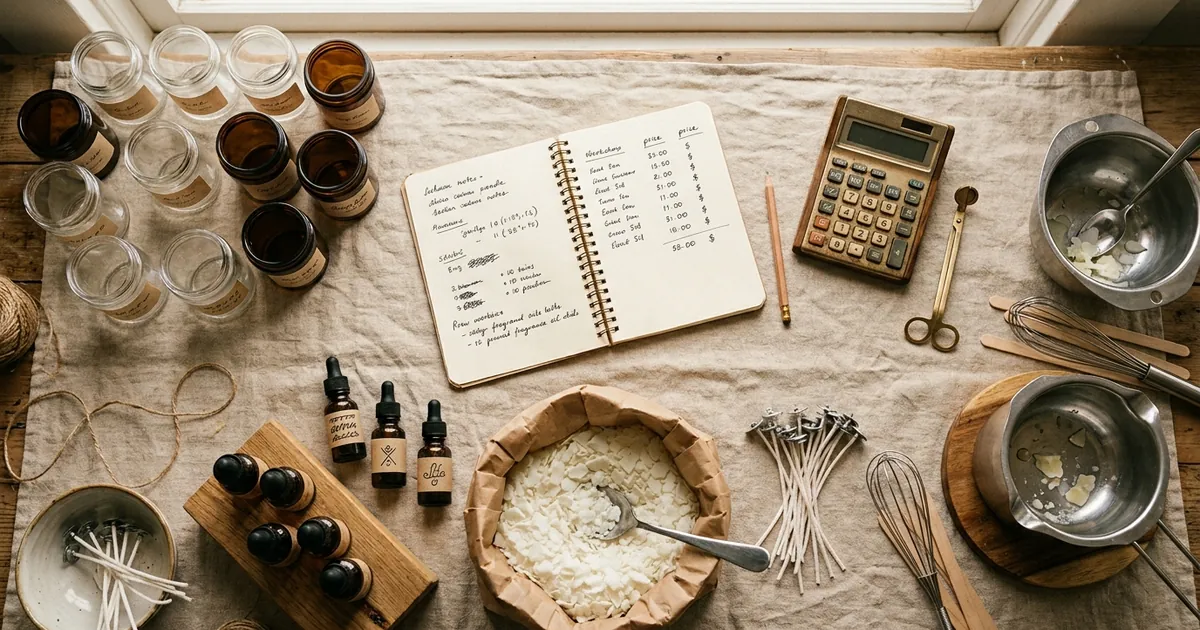
Most people price their first workshop by looking at what others charge and picking something a bit lower. That feels safe, but it often means working a full Saturday for very little once materials and the venue are paid.
A better starting point is your own numbers. This guide gives you a simple formula, a worked example, and a few ways to adjust the price once you see how people book.
Step 1: List every cost of one session
Think of one single session from start to finish and write down everything it costs you. Most workshops have the same groups of costs:
- Materials per person. Wax, wicks, jars, fragrance, clay, canvases, ingredients. Whatever each participant uses or takes home.
- Venue. Room hire for the session, or a fair share of your studio rent.
- Fixed session costs. Things you pay once per session no matter how many people come: an assistant, equipment wear, cleaning, snacks and drinks for the table.
- Your time. Not only the two hours of teaching, but also preparation, setup, cleanup and answering questions. Decide what an hour of your time is worth and count all those hours.
- Booking and payment fees. Card payments are never free. Include the fee per ticket so it does not quietly eat your margin.
Step 2: Decide how many seats you will really fill
This is the number most people get wrong. If your table fits 12, do not divide your costs by 12. Divide by the number you realistically expect, especially for your first few dates. A safe planning number is the seats you are fairly sure to sell, not the maximum you could squeeze in.
Pricing for a realistic group means a session with a few empty seats still pays for itself, and a full session becomes a good day.
Step 3: Use the formula
Price per seat = (fixed session costs ÷ expected seats) + materials per person + your margin per seat
Your time can sit inside the fixed costs (as hours × your hourly rate) or inside the margin. Pick one way and stick to it so you do not count it twice.
A worked example: a candle-making workshop
Here is an example with made-up but plausible numbers. Replace them with your own.
| Item | Cost |
|---|---|
| Room hire for 3 hours | 90 |
| Your time: 5 hours (prep, teaching, cleanup) at 25 per hour | 125 |
| Equipment wear and cleaning | 15 |
| Fixed costs per session | 230 |
| Materials per person (wax, wick, jar, fragrance, packaging) | 9 |
With 10 seats available and 8 expected:
- Fixed costs per expected seat: 230 ÷ 8 = 28.75
- Plus materials: 28.75 + 9 = 37.75
- That is your break-even price per seat, with your time already paid.
From there, add a margin so the business can grow, buy better supplies and cover quiet months. A price around 45 to 48 in this example covers everything with room to spare. If the session sells all 10 seats, the extra two seats are almost pure profit, because the fixed costs were already covered.
Then check the price against the fees. If your booking tool takes a percentage plus card processing, make sure the amount you receive after fees still clears your break-even.
Step 4: Check it against the market, not the other way round
Now look at what similar workshops nearby charge. Three things can happen:
- Your price is close to theirs. Good, you are in the right range.
- Your price is much higher. Look for costs you can lower (a cheaper room, buying materials in bulk) or make the workshop feel worth more: a bigger finished piece, a drink included, a smaller group.
- Your price is much lower. You may be undercharging. People often read a very low price as lower quality, especially for gifts and date nights.
Ways to adjust without discounting
Cutting the price is the easiest move and usually the worst one. Try these first:
- Ticket types. Offer a standard seat and a “two people” ticket, or a premium option with an extra piece to take home.
- Group size. A smaller, more personal group can justify a higher price.
- Private sessions. Birthdays, hen parties and team events usually pay a flat price for the whole room.
- A limited early price. A handful of cheaper seats for people who book early helps you fill the first places and see demand sooner.
Show one clear price
Whatever you decide, show buyers one simple, final price. A price that grows at checkout because of service fees makes people hesitate right at the moment they are about to pay. Pick a booking setup where the fees come out of your payout instead of being added on top for the buyer, and build those fees into your price using the formula above.
Quick recap
- Add up every cost of one session, including your time.
- Divide fixed costs by the seats you expect to fill, not the maximum.
- Add materials and a margin per seat.
- Compare with the market, then adjust value before you lower the price.
- Show one clear, final price.
Passfinch lets you set one price per ticket type, and that is exactly what buyers pay. On the Free plan we keep 3% of each paid ticket plus card processing, taken from your payout. See how it works for candle-making workshops.